Ruffneck FX6 & FX6-SD Explosion-Proof Unit Heaters
Understand FX6 and FX6-SD applications, key differences, hazardous-location selection, controls and the information needed for a heater quote.
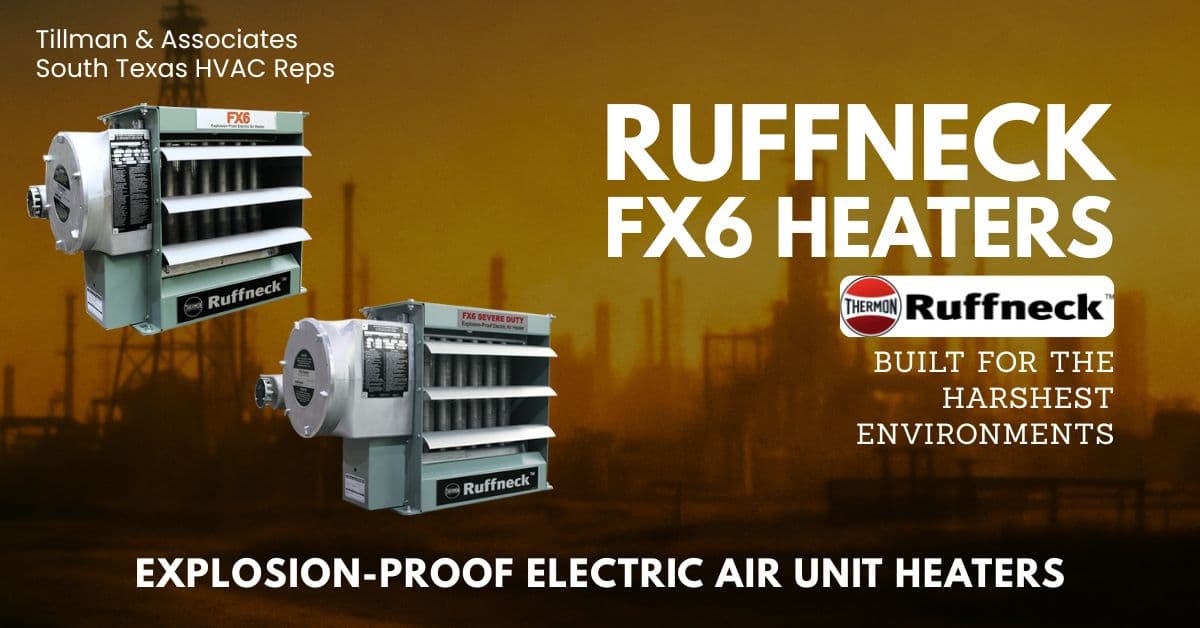
Start with your project requirements
Use our product selection tools to prepare the equipment details for review.
Explore Thermon heater selectionTechnical literature
- Ruffneck FX6 catalog ↗
Catalog · PDF · 6 pages · View or save from the PDF viewer
- Ruffneck FX6 installation and maintenance manual ↗
Manual · PDF · 44 pages · View or save from the PDF viewer
Manufacturer-hosted technical documents. Page links use PDF page numbers; some viewers open at the first page. Confirm the document revision and exact model before ordering.
Ruffneck FX6 is an electric, fan-forced unit heater for dry indoor industrial spaces with a specified hazardous-location classification. The related FX6-SD is intended for severe-duty conditions. Selecting either starts with the area classification, required heating duty and electrical supply—not simply the size of the room.
Tillman & Associates helps contractors, facility teams and engineers match these requirements and prepare heater, control and mounting inquiries across South Texas.
Ask Tillman about an FX6 or FX6-SD application →
How the FX6 heats an industrial space
The heater combines an electric heat source, a liquid-filled core and a motor-driven fan. Air moves over the finned heat exchanger and returns to the space as heated air. Adjustable discharge louvers help direct that airflow. This is space-heating equipment; a request to heat an inline duct or process stream needs a different product review.
The FX6 catalog identifies applications such as refineries, petrochemical facilities, grain handling and wastewater treatment. A facility name alone does not establish suitability: the actual installation location and the selected heater nameplate must match.
FX6 versus FX6-SD: what changes?
| Family | Application starting point | What to review |
|---|---|---|
| FX6 | Dry indoor hazardous-location space heating. | Heating duty, certification, supply power, installation conditions and controls. |
| FX6-SD | Severe-duty service involving vibration, variable power quality or temporary generation. | The SD protection arrangement and the exact installation limits, in addition to the normal selection requirements. |
The SD catalog describes a shunt-trip circuit breaker actuated by a redundant core temperature limit independently of the control circuit. It also lists heavier electrical components. Those are specific construction differences; “severe duty” does not mean the unit can be installed outdoors, washed down or left without maintenance.
Features that matter during selection
- Layered protection: the FX6 catalog describes two levels of thermal protection and primary and secondary pressure protection. These protective devices must remain functional.
- Cold-weather capability: the catalog lists operation down to −58°F (−50°C). Check the full ambient range and the selected model’s limits.
- Controls: built-in thermostat, disconnect and other factory options depend on the exact electrical model. An option shown for the family may not be available on every unit.
- Mounting and access: select the appropriate mounting kit and allow space for air circulation and service. A replacement should be checked against the existing mounting arrangement.
Hazardous-location rating is an exact-model question
The FX6 catalog lists Class I, Division 1 and 2, Groups C and D; Class II, Division 1, Groups E, F and G; Class II, Division 2, Groups F and G; and Class I, Zones 1 and 2, Groups IIA and IIB. It identifies temperature code T3B, 329°F (165°C).
Some electrical models have narrower approvals. For example, the catalog restricts 480 V single-phase models to Class I, Division 1, Group D and Class II, Division 1, Groups F and G. Use the selected unit’s nameplate and current manufacturer documentation to confirm suitability. Send the project’s required classification with your inquiry; do not infer it from another heater in the building.
Installation and maintenance considerations
FX6 equipment is for dry indoor service. The owner’s manual excludes rain or snow exposure, limits ambient temperature to 104°F (40°C), and prohibits operation in atmospheres corrosive to steel or aluminum. Optional materials or coatings require an application review.
Qualified personnel must follow the installation and maintenance manual. Review clearances, mounting, electrical protection and the maintenance schedule before purchase. For replacement work, include the complete heater model and serial number rather than ordering from cabinet appearance alone.
What to send for a heater quote
- The required class, division or zone, gas/dust group and temperature code.
- Calculated heat loss or required kW, indoor design temperature and lowest outdoor design condition.
- Voltage, phase, frequency and whether power comes from a generator.
- Mounting height, available space, airflow obstructions and photographs of the location.
- Vibration, moisture and chemical exposure; thermostat, disconnect and other control requirements.
- For replacements: model/serial labels, quantity and the existing mounting kit.
Common FX6 questions
Does explosion-proof mean weatherproof?
No. Hazardous-location suitability and weather exposure are separate selection questions. FX6 and FX6-SD catalogs specify dry indoor installation.
Can I select a heater by voltage and kW alone?
No. Those identify only part of the requirement. Classification, temperature code, phase, frequency, ambient limits and installation details still need review.
Can I use the online builder for an FX6-SD?
Our current guided builder covers reviewed standard FX6 configurations. Send severe-duty and special-model requests to Tillman for review.
Technical references and next steps
- FX6 catalog — applications, ratings and model options (PDF)
- FX6-SD catalog — severe-duty construction and installation conditions (PDF)
- FX6 owner’s manual — Part 13988, Rev. 1.09, January 2026 (PDF)
- Prepare a standard FX6 configuration
- Review mounting and control accessories
Technical content reviewed November 12, 2026. Catalog tables and manuals provide model-specific details; confirm the documents supplied for your selected equipment.
Have a specification, existing heater or project question? Contact Tillman for selection and quotation assistance.
Related posts
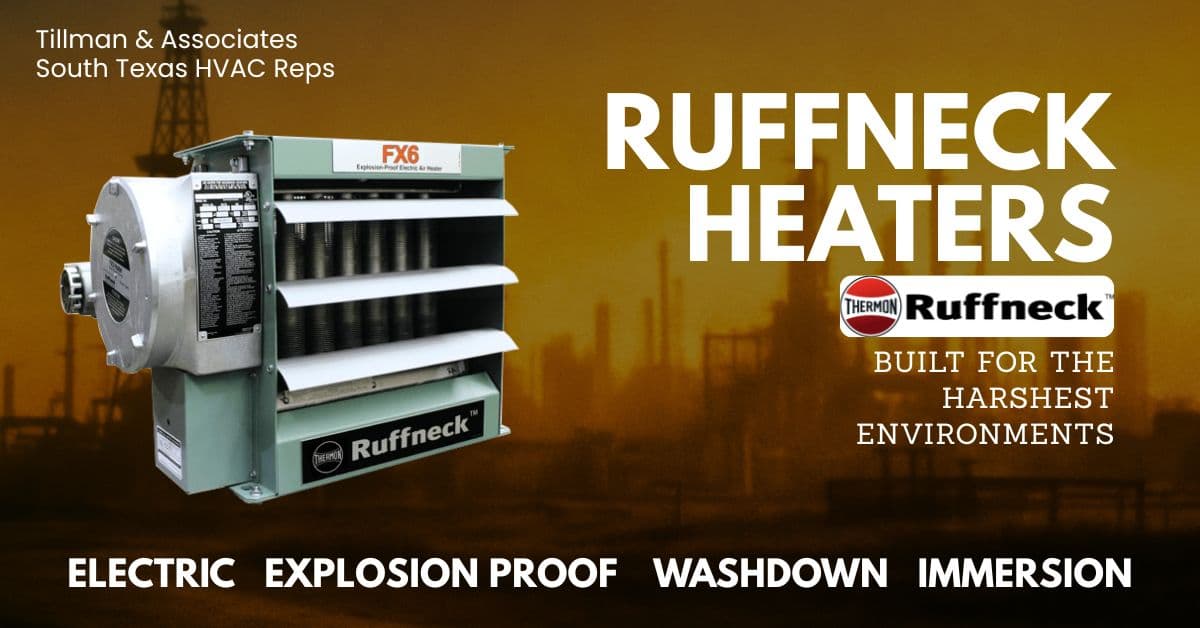
Ruffneck Industrial Heating for South Texas | Tillman & Associates HVAC Experts
Ruffneck Heaters: Industrial Heating Solutions for South Texas Facilities When you think of industrial-strength heating built to withstand the harshest environments, one name stands out: Ruffneck®. Proudly manufactured by Thermon, Ruffneck heaters are the gold standard in high-performance, heavy-duty space heating for industrial settings. While South Texas may not see months of snow and ice,